
AC Not Blowing Cold Air? 8 Common Causes and What to Do
CALL NOW (970) 818-1613We pick up the phone, 24/7
CALL NOW (970) 818-1613Is your AC not blowing cold air when you need it most? Before you assume the worst, know that this is one of the most common cooling complaints we hear from homeowners across Northern Colorado, especially once summer temperatures start climbing. The good news: many causes are straightforward, and some you can troubleshoot yourself in minutes.
This guide walks you through the eight most common reasons your AC is not blowing cold air, which ones you can check on your own, and when it is time to call a licensed HVAC technician.
Quick Summary
If your air conditioner is not cooling your home, start with these three checks before anything else:
- Thermostat settings — Make sure the mode is set to “Cool” and the fan is on “Auto,” not “On.”
- Air filter — Pull the filter out and hold it up to light. If no light passes through, replace it.
- Outdoor unit — Check that the condenser unit outside is running and clear of debris.
If those three checks do not resolve the issue, the cause is likely one of the more involved problems covered below, and professional diagnosis is the safest next step.
How Your Air Conditioner Cools Your Home
Understanding the basic cooling cycle helps explain why warm air comes out of your vents when something goes wrong.
When your thermostat calls for cooling, your AC system follows this sequence:
- The thermostat signals the system to start.
- The compressor pressurizes refrigerant and sends it to the outdoor condenser coil.
- The condenser fan blows outdoor air across the coil, releasing heat from the refrigerant.
- The cooled refrigerant travels to the indoor evaporator coil.
- The blower fan pushes warm indoor air across the cold evaporator coil, cooling the air.
- The cooled air circulates through your ductwork and into your rooms.
If any step in this process fails, the blower may still run, but the air coming from your vents will not be cold. That is why your AC can sound like it is running normally while delivering warm or room-temperature air.
1. Thermostat Settings Are Incorrect
This is the most common reason for an AC not blowing cold air, and it is also the easiest to fix.
Check these settings first:
- Mode setting: Make sure your thermostat is set to “Cool,” not “Heat,” “Fan Only,” or “Off.”
- Fan setting: If your thermostat fan is set to “On” instead of “Auto,” the blower runs continuously, even when the AC is not actively cooling. The air coming through your vents will feel warm or room temperature between cooling cycles. Switch it to “Auto” so the fan only runs when the system is producing cold air.
- Temperature setpoint: Verify the set temperature is at least 3 to 5 degrees below the current room temperature.
- Batteries: Dead or weak thermostat batteries can cause erratic behavior, including failure to signal the AC to start. Replace them if the display looks dim or blank.
- Programmable schedules: If you have a programmable or smart thermostat, check that a schedule is not overriding your manual settings.
If adjusting these settings restores cold air, you have solved the problem. If not, move on to the next cause.
2. Dirty or Clogged Air Filter
A dirty air filter is one of the most frequent and most preventable reasons an air conditioner stops blowing cold air. We see this issue regularly during summer service calls in Fort Collins, Loveland, and throughout Northern Colorado.
Here is what happens: when the filter is clogged with dust, pet hair, pollen, and debris, it restricts airflow into the system. With reduced airflow, the evaporator coil gets too cold and can freeze over completely. A frozen coil cannot absorb heat from your indoor air, so the system blows warm or room-temperature air instead.
What to do:
- Turn off your AC system.
- Locate the air filter, usually near the return air duct or inside the air handler.
- Pull out the filter and hold it up to a light source. If you cannot see light through it, the filter needs to be replaced.
- Install a new filter that matches the correct size and MERV rating for your system.
We recommend checking your filter monthly and replacing it every one to three months, depending on your household. Homes with pets, nearby construction, or allergy sufferers may need more frequent changes.
If you replace the filter and the AC still is not cooling after restarting, the system may have a deeper issue that requires professional AC repair.
3. Frozen Evaporator Coil
A frozen evaporator coil is both a cause and a symptom. When ice forms on the coil, it blocks airflow and prevents the refrigerant from absorbing heat. Your AC will continue running but will not produce cold air.
Common causes of a frozen evaporator coil:
- Restricted airflow from a dirty filter, blocked return vents, or closed registers
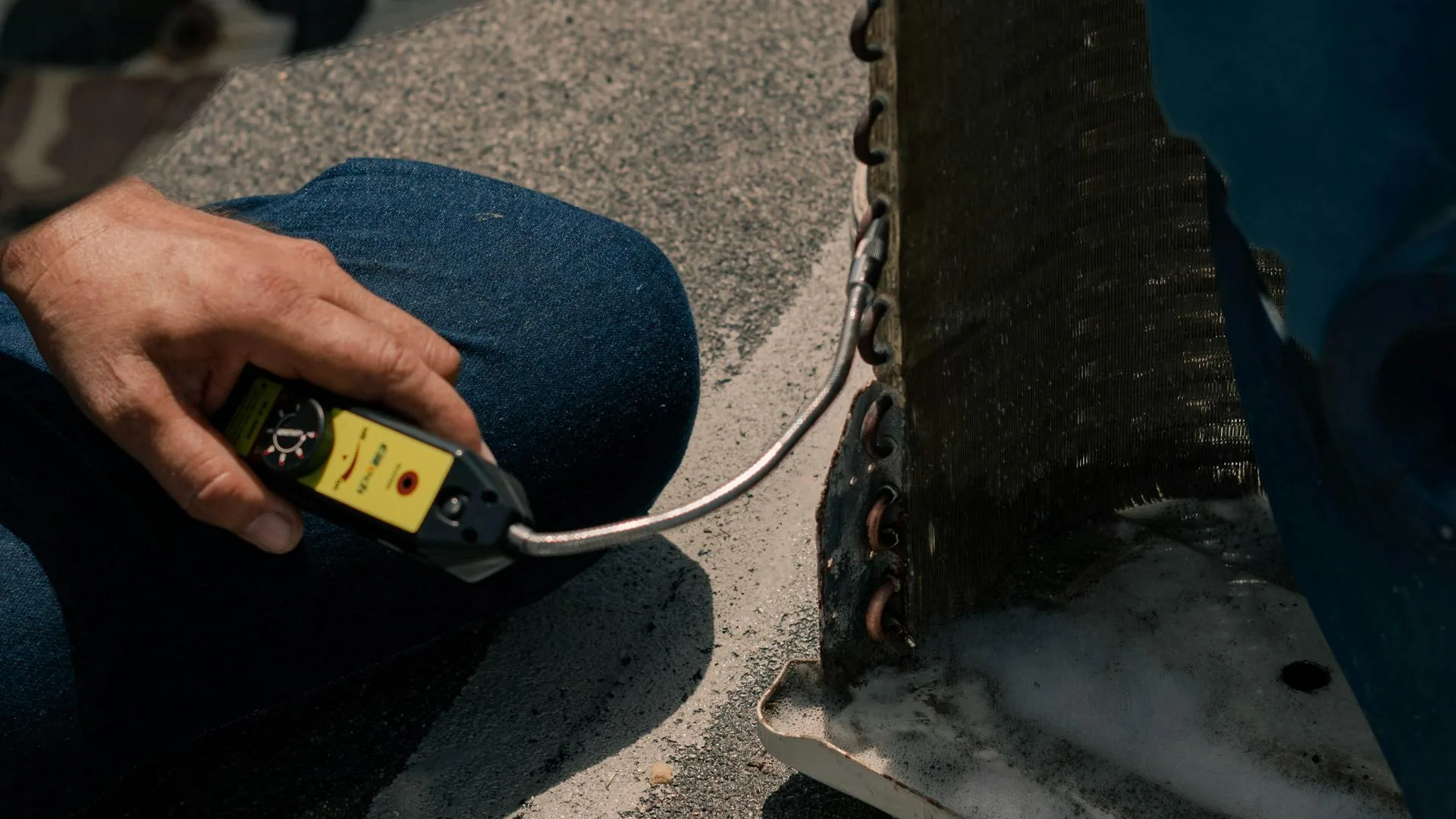
- Low refrigerant levels due to a leak in the system
- Dirty evaporator coil that reduces heat transfer efficiency
- Blower motor problems that reduce the volume of air moving across the coil
Signs your coil may be frozen:
- Ice visible on the refrigerant lines or indoor unit
- Water pooling around the indoor air handler
- The AC runs but produces little to no cooling
- Unusually high humidity inside your home
What to do:
- Turn off the AC and switch the fan to “On” to circulate warm air across the coil and help it thaw. This can take 1 to 24 hours depending on the amount of ice buildup.
- Check and replace the air filter.
- Make sure all supply and return vents throughout your home are open and unblocked.
- Once the coil is thawed, restart the system and monitor whether cooling returns.
If the coil freezes again within a day or two, there is an underlying issue, likely low refrigerant or a mechanical problem, that requires a licensed HVAC technician to diagnose.
4. Refrigerant Leak
Refrigerant is the substance that makes cooling possible. It cycles between the indoor evaporator coil and the outdoor condenser, absorbing heat from your home and releasing it outside. Your AC does not consume refrigerant during normal operation, so if levels are low, it means there is a leak somewhere in the system.
Signs of a refrigerant leak:
- AC running but not cooling your house, even after hours of operation
- Hissing or bubbling sounds near the indoor or outdoor unit
- Ice forming on the refrigerant lines or evaporator coil
- Higher-than-normal electric bills as the system runs longer to compensate
- Warm air from the vents that never gets cold
Low refrigerant is not a DIY fix. Refrigerant handling requires EPA certification, specialized equipment, and proper leak detection. Continuing to run the system with low refrigerant can damage the compressor, which is one of the most expensive components to replace.
If you suspect a refrigerant leak, turn off your AC and call a professional. At JT Plumbing Heating & Air, our licensed technicians can locate the leak, repair it, and recharge your system to the manufacturer-specified level. Call us at (970) 818-1613 for a diagnosis.
5. Dirty or Blocked Condenser Unit
The outdoor condenser unit is responsible for releasing the heat that your AC pulls from inside your home. If the condenser coils are dirty or the unit is obstructed, heat cannot escape efficiently, and your air conditioner will struggle to cool.
Common condenser problems:
- Debris buildup: Leaves, grass clippings, cottonwood seeds, and dirt accumulate on the condenser fins and reduce airflow. This is especially common in Northern Colorado during spring and early summer.
- Overgrown vegetation: Shrubs, bushes, or fencing too close to the unit restrict airflow.
- Bent or damaged fins: The thin aluminum fins on the condenser coil can bend from impacts, hail, or debris, blocking air passage.
What to do:
- Turn off the AC system.
- Clear any debris, leaves, or vegetation within at least 2 feet around the outdoor unit.
- Gently rinse the condenser coils with a garden hose, spraying from the inside out. Do not use a pressure washer, as it can damage the delicate fins.
- Straighten any bent fins with a fin comb if you have one available.
- Restart the system and check whether cooling improves.
If the condenser fan is not spinning when the system is running, the fan motor or its capacitor may have failed. This is a repair that should be handled by a professional.
6. Electrical and Capacitor Failures
Your air conditioner relies on several electrical components to start and run. When these components fail, the system may seem like it is operating normally from inside your home while the outdoor unit is partially or completely shut down.
Common electrical issues:
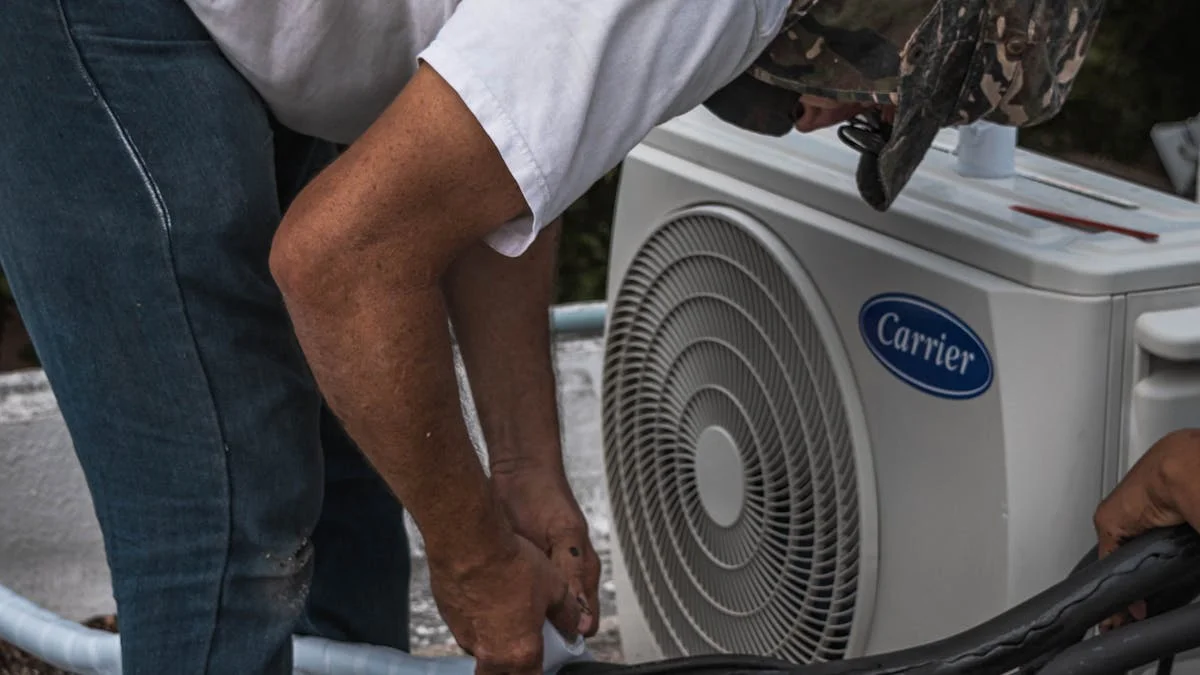
- Capacitor failure: Capacitors provide the electrical boost needed to start the compressor and condenser fan motor. A failing capacitor may cause the outdoor unit to hum without starting, or the compressor may start and then shut off within seconds. Capacitors degrade over time, and Colorado’s temperature swings accelerate this wear.
- Tripped circuit breaker: The outdoor unit and indoor air handler often run on separate breakers. If the outdoor unit’s breaker trips, the indoor fan keeps blowing but no cooling occurs because the compressor and condenser are not running.
- Contactor problems: The contactor is a switch that sends power to the compressor and condenser fan when the thermostat calls for cooling. Burned or pitted contacts can prevent the outdoor unit from receiving power.
What to check:
- Check your electrical panel for a tripped breaker. Reset it once. If it trips again immediately, do not reset it again as there may be a short circuit.
- Listen to the outdoor unit. If you hear a humming or clicking sound but the fan is not spinning, the capacitor or fan motor may have failed.
- If the outdoor unit is completely silent when the thermostat is calling for cooling, the contactor or a wiring issue may be the cause.
Electrical repairs involve high-voltage components and should only be performed by a qualified technician. Do not attempt to test or replace capacitors, contactors, or wiring yourself.
7. Ductwork Leaks and Airflow Problems
Even when your AC system is producing cold air, leaky or poorly insulated ductwork can prevent that cold air from reaching your living spaces.
Ducts running through unconditioned areas like attics, crawl spaces, and unfinished basements are especially vulnerable. Cracks, loose connections, and deteriorating seals allow cooled air to escape before it reaches your vents. At the same time, hot air from these unconditioned spaces gets pulled into the duct system, warming the air before it reaches your rooms.
Common signs of duct problems:
- Some rooms are cool while others stay warm
- Your AC runs longer than usual but your home never reaches the set temperature
- Higher energy bills without a change in usage
- Visible gaps or disconnected sections in exposed ductwork
- Weak airflow from certain vents
The Department of Energy estimates that typical homes lose 20 to 30 percent of conditioned air through duct leaks and poor connections. In Northern Colorado, where summer afternoon temperatures regularly reach the 90s, duct losses mean your AC has to work significantly harder and longer to keep up.
A professional duct inspection can identify leaks and determine whether sealing or insulation repairs are needed. This is one improvement that often pays for itself through lower energy bills and more consistent comfort throughout your home.
8. Compressor Failure
The compressor is the heart of your air conditioning system. It pressurizes refrigerant and drives the entire cooling cycle. When the compressor fails, the AC will run but produce no cooling at all.
Signs of compressor problems:
- The outdoor unit runs but makes unusual noises such as grinding, rattling, or clicking
- The outdoor unit is completely silent even though the thermostat is calling for cooling
- The circuit breaker for the outdoor unit trips repeatedly
- The AC blows warm air despite all other components appearing to function normally
Compressor failure is typically caused by long-term stress from other unresolved issues: low refrigerant, electrical problems, dirty coils, or restricted airflow. It is one of the most expensive AC repairs, and in some cases, full system replacement is more cost-effective than replacing the compressor alone.
If you suspect compressor failure, stop running the system and schedule a professional evaluation. Running a failing compressor can cause additional damage to the system.
When to Call a Professional HVAC Technician
Some AC issues are safe for homeowners to troubleshoot: checking thermostat settings, replacing air filters, clearing debris from the outdoor unit, and opening blocked vents. Beyond those basics, air conditioner repair involves refrigerant, high-voltage electrical components, and sealed systems that require professional training and equipment.
Call a licensed HVAC technician if:
- Your AC continues to blow warm air after checking the thermostat and filter
- You see ice on the refrigerant lines, evaporator coil, or outdoor unit
- The outdoor unit is not running or makes unusual sounds
- Your circuit breaker trips repeatedly when the AC is running
- You notice a chemical or burning smell coming from the system
- Your energy bills have increased significantly with no change in usage
- The AC short-cycles, turning on and off every few minutes
At JT Plumbing Heating & Air, we provide AC repair in Fort Collins and throughout Northern Colorado, including Loveland, Windsor, Greeley, Wellington, Berthoud, Longmont, Johnstown, Eaton, Evans, and Mead. Our licensed technicians are available with 24/7 live answering, so you never have to wait when your AC stops cooling in the middle of a Colorado heat wave.
Call us at (970) 818-1613 for same-day AC diagnosis and repair. We offer free estimates on HVAC services.
Prevent AC Problems Before They Start
The most effective way to avoid an air conditioner not cooling is regular preventive maintenance. Annual tune-ups catch small issues, like a dirty coil or a weak capacitor, before they leave you without cold air on the hottest day of the year.
What a professional AC tune-up includes:
- Full system inspection and safety check
- Refrigerant level verification
- Evaporator and condenser coil cleaning
- Electrical connection inspection and tightening
- Thermostat calibration verification
- Airflow and ductwork assessment
- Filter inspection and replacement recommendations
For year-round protection, our VIP Club Maintenance Plan at $399 per year covers annual AC and furnace tune-ups, priority scheduling, member-only discounts, and waived consultation fees. It is the simplest way to keep your system running efficiently and catch problems before they leave you uncomfortable.
Frequently Asked Questions
Why is my AC running but not cooling the house?
If your AC is running but not cooling, the most likely causes are a dirty air filter restricting airflow, incorrect thermostat settings, low refrigerant from a leak, or a dirty condenser unit outside. Start by checking the filter and thermostat. If those are fine, the issue likely requires professional diagnosis.
Can a dirty air filter really stop my AC from cooling?
Yes. A clogged filter restricts airflow, which can cause the evaporator coil to freeze over. A frozen coil cannot absorb heat from your indoor air, so the system blows warm air even though it is running. This is one of the most common causes we see during summer service calls in Northern Colorado.
How do I know if my AC has a refrigerant leak?
Common signs include hissing or bubbling sounds near the unit, ice on the refrigerant lines, the AC running constantly without cooling your home, and higher electric bills. Refrigerant leaks require professional repair since the substance requires EPA-certified handling and specialized equipment.
Should I turn off my AC if it is not blowing cold air?
It depends on the cause. If the evaporator coil is frozen, turning off the AC and switching the fan to “On” allows the coil to thaw. If you hear unusual sounds from the outdoor unit or the breaker keeps tripping, turn off the system to prevent further damage and call a technician.
How often should I have my AC serviced?
Schedule a professional AC tune-up at least once per year, ideally in spring before the cooling season begins. Between service visits, check your air filter monthly and keep the outdoor condenser unit clear of debris. Our VIP Club members receive annual AC and furnace inspections as part of their plan.
When should I replace my AC instead of repairing it?
Consider replacement if your AC is more than 15 years old, requires frequent repairs, uses R-22 refrigerant (which is phased out), or if repair costs exceed 50 percent of a new system. A new high-efficiency system can also significantly reduce your monthly energy bills. Read our guide on AC installation costs for a full breakdown.
Serving Northern Colorado
 All Service Areas


Serving our Community
At JT Plumbing Heating & Air, we feel it’s important to support our Northern Colorado community and the causes that are close to our family. Every year we support local charities, nonprofits, and sponsor community activities that are important to us. Learn more about the causes we support and how you can help.
COMMUNITY INVOLVEMENT